


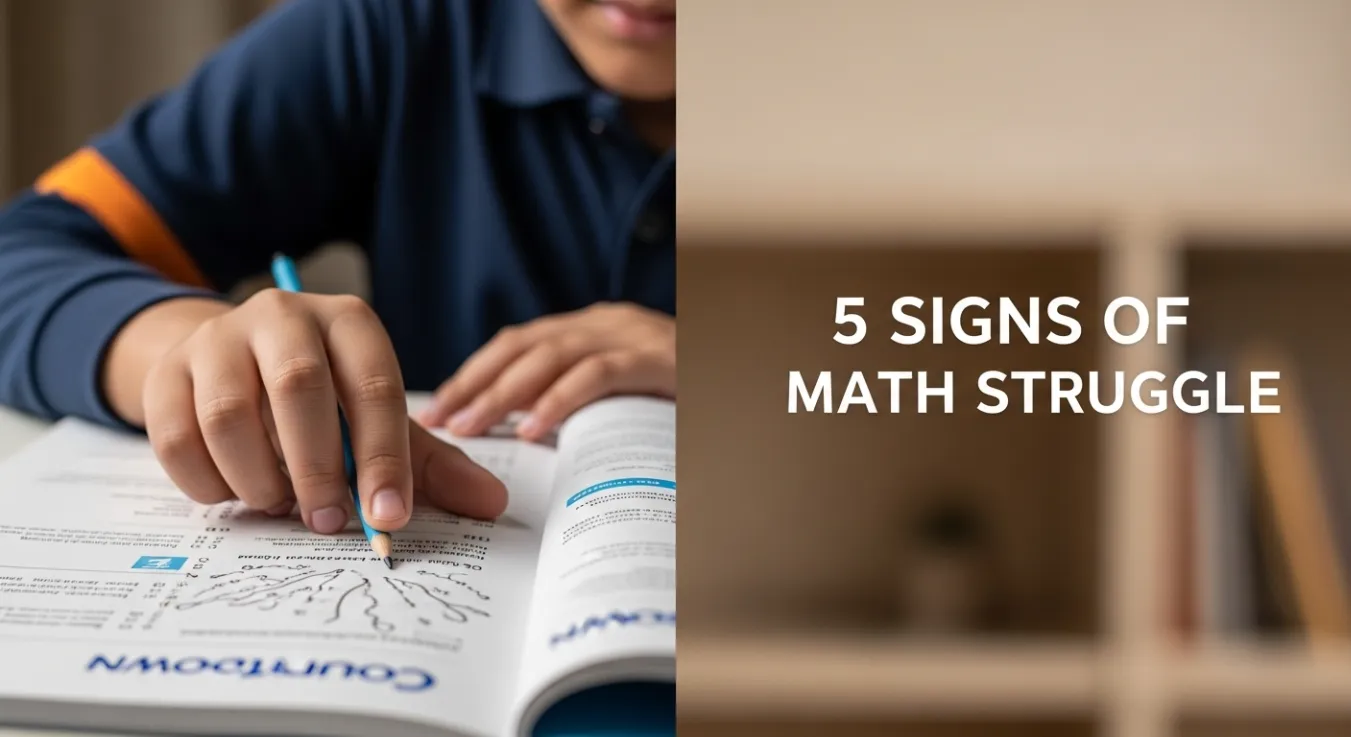
To determine if your child needs a Math intervention before the next academic session, look for these five critical signs: constant frustration with Oxford New Countdown homework, reliance on finger-counting past Grade 4, inability to translate word problems into equations, physical anxiety (like stomach aches) before math class, and a consistent decline in monthly test grades despite effort. Identifying these gaps now prevents them from becoming permanent roadblocks in O Levels.
Key Takeaways:
- Math is Cumulative: Unlike History, you can’t understand Grade 5 Math if you missed Grade 4 concepts. The gap only gets wider.
- The “Countdown” Effect: The Oxford New Countdown books used in Lahore schools are conceptually difficult. Parents often struggle to teach them.
- Behavioral Cues: “I hate Math” is usually code for “I don’t understand Math.”
- The Solution: A specialized Female Home Tutor can rebuild the foundation in 2 months before the new session begins.
It is mid-January. The winter break is over, and if your child goes to LGS, Beaconhouse, or The City School, you know what’s coming next: Final Term Exams.
As parents, we often focus on the report card. If we see a passing grade (even a low one), we assume everything is fine. We promote them to the next class and buy the new books.
But here is the scary truth about Math: It is a spiral.
If your child didn’t fully grasp Fractions in Class 3, they will inevitably fail Decimals in Class 4. If they don’t get Decimals, they will drown in Algebra in Class 6. By the time they reach O Levels, the damage is done.
At Roots Home Tutors, we see this pattern every year in Johar Town and DHA. Parents call us in Grade 9 saying, “My son hates Math.” The reality? He doesn’t hate Math; he just missed a step in Grade 5.
Here are 5 silent signs that your child isn’t ready for the next grade and needs a Maths home tutor intervention now.
1. The “Oxford Countdown” Tears 😭
Let’s be honest—the New Oxford Countdown (Second/Third Edition) books are tough. They introduce complex concepts like LCM/HCF, Integers, and Geometry much earlier than the old matric system did.

The Sign:
Does your child stare at their Math homework for 20 minutes without writing a single number? Do they say, “The teacher teaches it differently,” when you try to help?
If homework time feels like a battlefield every evening, it’s not because your child is lazy. It’s because they are lost. A professional home tutor for kids knows the specific methodology these books require.
2. They Still Rely on Finger Counting (Grade 4+) 🖐️
By Grade 4 or 5, basic arithmetic (addition/subtraction) should be mental.
The Sign:
Watch your child solve a sum. are they tapping their fingers or drawing lines on the side of the page?
This indicates a lack of Number Sense. As they move to the next grade, the sums will get larger and the time will get shorter. Finger counting won’t work in Class 6.
We provide specialized Female home tutor in Lahore experts who use Montessori methods to transition kids from physical counting to mental math.
3. The “Word Problem” Paralysis 📝
In schools like TNS Beaconhouse or Learning Alliance (which follow IB/PYP or modern curriculums), Math isn’t just 2 + 2. It is a story.
Example: “If Ali has 5 apples and gives half to Sara…”
The Sign:
Your child can solve the numbers but freezes when they see a paragraph.
This is a literacy-numeracy gap. They don’t know how to translate English words into Mathematical operations. A home school tutor helps bridge this gap by teaching them to hunt for keywords (e.g., “Total” means Add, “Difference” means Subtract).
4. Avoidance and “Stomach Aches” 🤢
Kids are smart. If they feel incompetent in a subject, they will try to escape it to protect their ego.
The Sign:
Does your child suddenly get a stomach ache or need to go to the bathroom right when Math class starts online? Or do they “forget” their Math notebook at school frequently?
This is anxiety. They are afraid of being asked a question they can’t answer. You don’t need a disciplinarian; you need a nurturing lady home tutor near me who can rebuild their confidence in a safe, one-on-one environment.
5. Grades Are Dropping (Even Slightly) 📉
Did they get an ‘A’ in Term 1, a ‘B’ in Mid-Terms, and now they are scraping a ‘C’ in monthly tests?
The Sign:
A downward trend is a red flag. It means the difficulty of the subject is increasing faster than their understanding. Sending them to the next grade without fixing this slide is setting them up for failure.
Living in DHA or Askari?
Don’t let traffic stop you from getting help. Our tutors come to you.
👉 Find a Home Tutor in DHA Lahore
The Solution: A 2-Month “Foundation Repair” 🛠️
If you recognized any of these signs, don’t panic. You have time before the new session starts in August.
You don’t need a strict academy. You need a Micro-Intervention.
At Roots Home Tutors, we specialize in Junior Grade Repair.
- Assessment: We check exactly where the gap is (is it Tables? Is it Division?).
- The Plan: We assign a verified Female home tutor to work strictly on those weak areas.
- The Goal: We ensure they enter the next grade feeling like a Math Wizard, not a victim.
Don’t wait for the Final Report Card.
The signs are already there.
Is your child ready for the next level?
Let’s make sure.
👉 Book a Free Academic Assessment Today
Is Your Child Ready for Next Grade? 5 Signs They Need Math Help – FaQs
How can I tell if my child is ready for the next grade in math?
A child is generally ready for the next grade in math if they understand current concepts, can solve grade level problems independently, and explain their thinking. Consistent homework completion and steady test performance are also indicators that foundational skills are in place.
What are common signs that a child may need math help?
- Frequent confusion with basic math concepts
- Difficulty completing homework without help
- Low confidence during math lessons or tests
- Slow problem solving compared to classmates
Is struggling with math normal at certain grade levels?
Yes, it is common for students to struggle during transition years when math becomes more complex. New topics such as multiplication, fractions, or algebra can be challenging. Temporary difficulty does not always mean a serious problem, but ongoing struggles may signal a need for extra support.
How does weak math foundation affect future grades?
A weak math foundation can make future topics harder to understand because math skills build on each other. Gaps in basic skills may lead to confusion, slower learning, and reduced confidence as students move into higher grades with more advanced concepts.
What behaviors might teachers notice if a child needs math help?
- Avoiding participation in math activities
- Frequent mistakes in simple calculations
- Difficulty following multi step problems
- Relying heavily on classmates for answers
Can math anxiety be a sign that my child needs support?
Math anxiety can indicate that a child feels overwhelmed or unsure about their skills. While some nervousness is normal, repeated stress, frustration, or avoidance of math tasks may suggest that the child would benefit from additional practice or guidance.
How can parents assess math readiness at home?
Parents can review schoolwork, observe homework habits, and ask their child to explain how they solve problems. Simple practice questions from the current grade level can also help identify whether the child understands key concepts or is memorizing without real understanding.
What role do test scores play in judging math readiness?
Test scores provide useful information but should not be the only measure of readiness. They show how well a child performs under exam conditions, but class participation, homework accuracy, and problem solving skills offer a more complete picture of math understanding.
When should parents consider extra math help?
- Grades decline over several months
- Homework takes unusually long to finish
- Basic concepts remain unclear after practice
- Teachers express ongoing concern
Can early math help improve confidence before the next grade?
Yes, early math help can strengthen understanding and improve confidence before a child moves to the next grade. Addressing gaps early allows students to feel more prepared, reduces stress, and helps them approach new topics with a more positive mindset.