


Struggling with complex organic mechanisms or thermodynamics calculations just months before your A Level Chemistry exams? An A Level Chemistry (9701) Crash Course provides the focused, intensive preparation Lahore students need to transform their grades from struggling to stellar in just 8 weeks. This comprehensive revision strategy targets the most challenging aspects of the Cambridge syllabus while addressing common Pakistani student weaknesses in practical analysis and calculation accuracy.
- 8-week structured revision plan covers all three chemistry domains with targeted past paper practice
- Paper 3 practical focus addresses alternative-to-practical scenarios that challenge most Lahore students
- Calculation mastery techniques for mole concepts, equilibrium constants, and thermodynamics
- Organic mechanism precision training with correct arrow notation and intermediate identification
- Proven grade improvement from D to A* grades through specialized tutoring approaches
Quick Answer
The most effective A Level Chemistry (9701) Crash Course for Lahore students combines intensive 8-week topic coverage with daily past paper practice, focusing heavily on calculation accuracy and Paper 3 practical analysis. Students typically see 2-3 grade improvements when following a structured plan that addresses common Pakistani student weaknesses in organic mechanisms and quantitative analysis, supported by experienced local tutors who understand Cambridge marking schemes.
What’s New in the 2026 A Level Chemistry (9701) Syllabus
The Cambridge International A Level Chemistry syllabus maintains its core structure for 2026, but understanding the current emphasis areas helps students focus their crash course preparation effectively. The paper structure remains unchanged with Paper 1 (MCQ), Paper 2 (AS structured questions), Paper 4 (A2 structured questions), and Paper 5 (practical exam with planning, analysis, and evaluation components) [3].
Key 2026 Focus Areas:
- Enhanced calculation requirements across all papers, particularly mole calculations and equilibrium constants
- Precision in organic mechanisms with stricter marking for arrow notation and intermediate structures
- Practical analysis skills emphasizing data interpretation and experimental design
- Quantitative analysis integration throughout inorganic and physical chemistry topics
The examination windows have expanded for 2026, with exams available in June and November series internationally, plus additional March sessions in India [4]. This gives Lahore students more flexibility in timing their A Level Chemistry (9701) Crash Course preparation.
Grading Standards Remain Consistent:
AS Level students receive grades a-e, while full A Level candidates earn grades A*-E [4]. No evidence suggests papers are becoming easier or harder – success depends on precise calculations, correct organic explanation mechanics, and detailed inorganic synthesis understanding [3].
Essential Topics for Your A Level Chemistry (9701) Crash Course
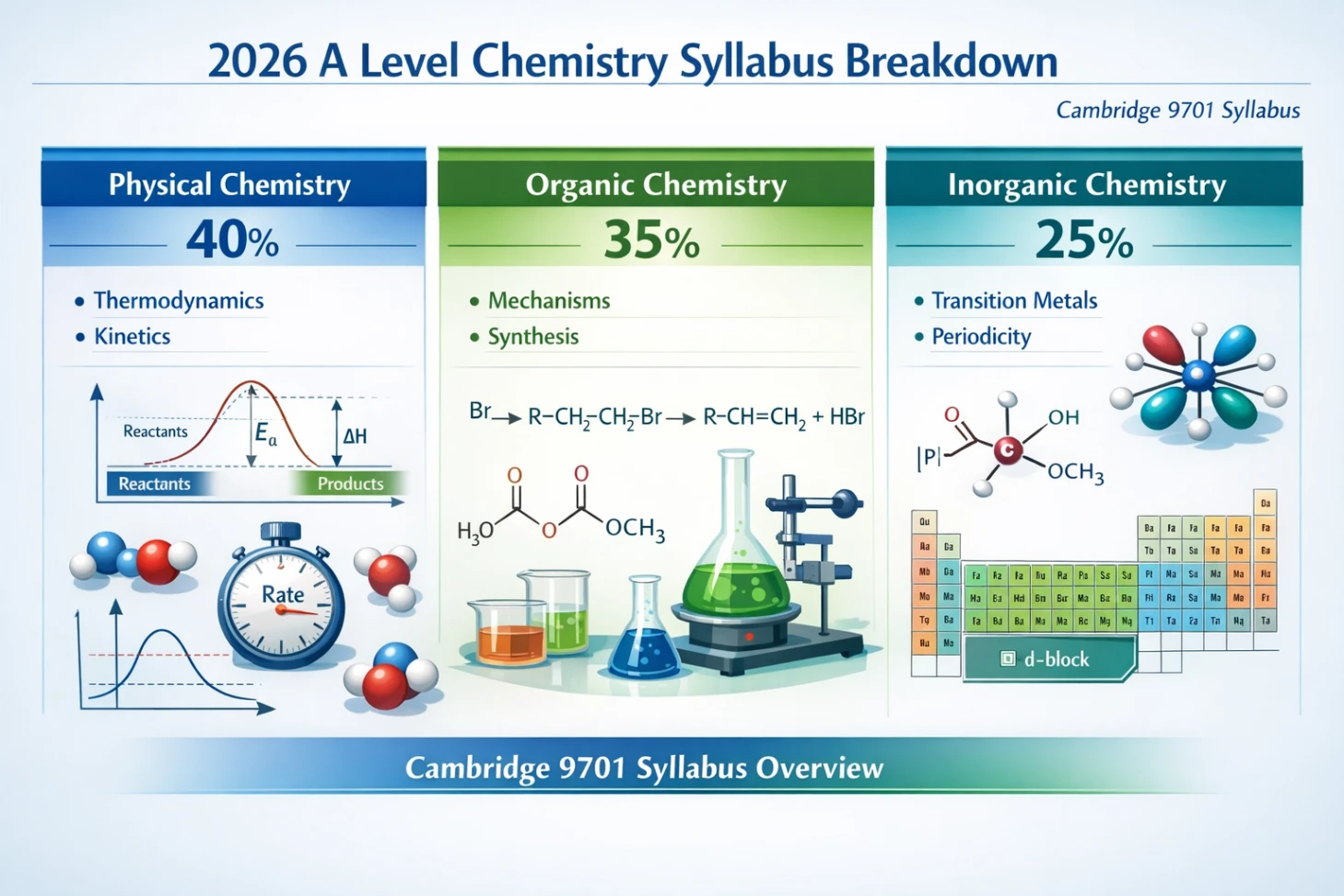
Physical Chemistry Priorities
Thermodynamics and Energetics:
- Enthalpy calculations with correct sign conventions
- Born-Haber cycles for ionic compound formation
- Entropy and Gibbs free energy relationships
- Lattice energy trends and calculations
Chemical Kinetics:
- Rate equation determination from experimental data
- Activation energy calculations using Arrhenius equation
- Reaction mechanism identification from rate laws
- Catalyst effects on reaction pathways
Chemical Equilibria:
- Kc and Kp calculations with proper units
- Le Chatelier’s principle applications
- Equilibrium position predictions
- Buffer solution pH calculations
Organic Chemistry Essentials
Reaction Mechanisms:
- Nucleophilic substitution (SN1 vs SN2) with correct arrow notation
- Electrophilic addition to alkenes and aromatic compounds
- Elimination reactions (E1 vs E2) and product prediction
- Carbonyl chemistry including aldol condensations
Synthesis Routes:
- Multi-step organic synthesis planning
- Reagent selection and reaction conditions
- Functional group interconversions
- Stereochemistry considerations in synthesis
Inorganic Chemistry Focus
Transition Metal Chemistry:
- Complex ion formation and geometry
- Variable oxidation states and electron configurations
- Catalytic properties and industrial applications
- Ligand substitution reactions
Periodicity and Group Trends:
- Atomic and ionic radius variations
- Ionization energy patterns
- Electronegativity and bonding predictions
- Acid-base properties across periods
For students seeking comprehensive support, Cambridge Curriculum Tutors in Lahore provide specialized expertise in these challenging topic areas.
8-Week A Level Chemistry (9701) Crash Course Timeline
This intensive revision schedule maximizes learning efficiency while ensuring comprehensive coverage of all examination topics.
Week 1-2: Physical Chemistry Foundation
Week 1 Focus:
- Atomic structure and bonding theories
- Thermodynamics: enthalpy, entropy, Gibbs free energy
- Daily practice: 10 calculation problems
- Past paper focus: Paper 2 Questions 1-3
Week 2 Focus:
- Chemical kinetics and rate equations
- Equilibrium constants and Le Chatelier’s principle
- Buffer calculations and pH problems
- Past paper focus: Paper 4 kinetics questions
Week 3-4: Organic Chemistry Intensive
Week 3 Focus:
- Hydrocarbon chemistry and functional groups
- Nucleophilic substitution mechanisms
- Elimination reactions and product prediction
- Daily practice: 5 mechanism problems
Week 4 Focus:
- Carbonyl chemistry and condensation reactions
- Aromatic chemistry and electrophilic substitution
- Multi-step synthesis planning
- Past paper focus: Organic synthesis questions
Week 5-6: Inorganic Chemistry Mastery
Week 5 Focus:
- Periodicity and group trends
- s-block and p-block element chemistry
- Acid-base theories and applications
- Past paper focus: Descriptive inorganic questions
Week 6 Focus:
- Transition metal chemistry and complexes
- Industrial processes and catalysis
- Extraction metallurgy
- Past paper focus: d-block element questions
Week 7: Paper 3 Practical Skills
Intensive Practical Training:
- Data analysis and graph interpretation
- Experimental design and planning
- Error analysis and improvement suggestions
- Alternative-to-practical scenarios
Daily Schedule:
- 2 hours: Past Paper 3 questions
- 1 hour: Data analysis practice
- 1 hour: Planning experiment exercises
Week 8: Final Revision and Mock Exams
Comprehensive Review:
- Complete past paper attempts under timed conditions
- Weak area identification and targeted practice
- Formula memorization and quick recall drills
- Exam technique refinement
Students following this timeline while working with experienced A Level tutors in Lahore typically see significant grade improvements within the 8-week period.
A Level Chemistry (9701) 8-Week Crash Course Planner
• Thermodynamics fundamentals
• Enthalpy calculations
• Equilibrium constants
• Buffer calculations
• Elimination reactions
• Mechanism notation
• Aromatic substitution
• Synthesis planning
• s & p-block chemistry
• Acid-base theories
• Complex formation
• Industrial catalysis
• Experimental design
• Error evaluation
• Weak area focus
• Exam technique
Mastering Paper 3: Common Mistakes and Scoring Strategies
Paper 3 represents the greatest challenge for most Lahore students in their A Level Chemistry (9701) Crash Course preparation. This practical paper tests experimental design, data analysis, and evaluation skills that require specific training beyond theoretical knowledge.
Alternative-to-Practical Scenarios
Data Analysis Excellence:
Students must demonstrate proficiency in graph plotting, trend identification, and quantitative analysis. Common errors include incorrect axis labeling, poor scale selection, and failure to draw best-fit lines through data points.
Key Success Strategies:
- Always use at least 50% of graph paper for plotting
- Include error bars when uncertainty data is provided
- Calculate gradients and intercepts with appropriate significant figures
- State conclusions that directly address the experimental aim
Experimental Design Planning:
The planning section requires students to design complete experiments including apparatus selection, procedure steps, safety considerations, and expected results.
Essential Planning Elements:
- Detailed apparatus diagrams with labels
- Step-by-step procedure with specific measurements
- Risk assessment and safety precautions
- Method for data collection and analysis
- Expected results with justification
Common Paper 3 Errors
Calculation Mistakes:
- Incorrect significant figure usage in final answers
- Unit errors in concentration and rate calculations
- Formula misapplication in equilibrium problems
- Percentage error calculations without proper rounding
Graph and Data Issues:
- Poorly drawn trend lines that ignore obvious outliers
- Incorrect uncertainty propagation in calculated values
- Missing error analysis and improvement suggestions
- Inadequate conclusion statements
Evaluation Weaknesses:
- Failure to identify major sources of systematic error
- Suggestions that don’t address identified problems
- Unrealistic improvement proposals
- Missing discussion of result reliability
Students working with specialized chemistry tutors learn systematic approaches to avoid these common pitfalls and maximize Paper 3 performance.
The Roots Advantage: Specialized A Level Chemistry (9701) Support
Expert Alternative-to-Practical Training
Roots Home Tutors provides specialized support for the most challenging aspects of A Level Chemistry, particularly Paper 3 practical skills that many Lahore students find difficult. Our chemistry tutors focus intensively on alternative-to-practical scenarios and data analysis techniques that directly impact examination performance.
Specialized Training Areas:
- Data interpretation mastery: Students learn systematic approaches to graph analysis, trend identification, and quantitative reasoning
- Experimental design skills: Comprehensive training in planning experiments with appropriate apparatus, procedures, and safety considerations
- Error analysis expertise: Detailed instruction in identifying sources of uncertainty and proposing realistic improvements
- Calculation precision: Intensive practice with significant figures, units, and formula applications
Targeted Weakness Identification
Our tutors understand common challenges faced by Pakistani students in A Level Chemistry, particularly in areas where local school preparation may be insufficient.
Focus Areas Include:
- Organic mechanism notation with correct arrow placement
- Thermodynamics calculations with proper sign conventions
- Equilibrium constant problems involving units and significant figures
- Inorganic synthesis routes with specific reagents and conditions
Students receive personalized attention that addresses individual weaknesses while building confidence in examination techniques.
Student Success Story: From D to A in 3 Months
“I was getting D grades in my chemistry mocks and felt completely lost with organic mechanisms and Paper 3 questions. After starting with Roots tutors in January 2026, everything changed. My tutor helped me understand the systematic approach to mechanism problems and taught me proper data analysis techniques for practical questions. By March, I was consistently scoring A grades in past papers. The focused crash course approach and individual attention made all the difference – I finally understood chemistry instead of just memorizing formulas.”
– Fatima Ahmed, DHA Phase 5, Lahore
This transformation represents the typical progress students achieve through structured A Level Chemistry (9701) Crash Course preparation combined with expert tutoring support.
Key Success Factors
Systematic Approach:
- Weekly topic mastery with immediate feedback
- Daily practice problems targeting weak areas
- Regular past paper attempts under timed conditions
- Continuous assessment and strategy adjustment
Individual Attention:
- Personalized study plans based on diagnostic assessment
- One-on-one explanation of difficult concepts
- Immediate correction of calculation and notation errors
- Confidence building through progressive difficulty increases
Students in areas like DHA, Gulberg, and Model Town have access to experienced tutors who understand both Cambridge requirements and local student needs.
A Level Chemistry Revision Strategies for Lahore Students
Daily Study Routine Optimization
Morning Sessions (2-3 hours):
Focus on the most challenging topics when mental energy is highest. Tackle organic mechanisms, thermodynamics calculations, or complex equilibrium problems during this period.
Afternoon Practice (1-2 hours):
Complete past paper questions under timed conditions. Focus on one paper type per day – alternate between Paper 2, Paper 4, and Paper 3 questions.
Evening Review (1 hour):
Review mistakes from the day’s practice, update formula sheets, and prepare materials for the next day’s study session.
Past Paper Strategy
Paper 1 (MCQ) Approach:
- Complete 40 questions in 35 minutes, leaving 20 minutes for review
- Mark uncertain answers for second-pass review
- Use elimination techniques for organic chemistry options
- Practice rapid calculation methods for physical chemistry
Paper 2/4 (Structured Questions):
- Read all questions first to identify easier starting points
- Show all working clearly with proper units
- Use bullet points for explanation questions
- Leave space for additions and corrections
Paper 3 (Practical):
- Spend adequate time on graph plotting and trend analysis
- Include detailed experimental procedures in planning questions
- Address all parts of evaluation questions systematically
- Practice data analysis with real experimental results
For students needing additional support, female tutors are available for families preferring same-gender instruction, particularly in conservative areas of Lahore.
Advanced Problem-Solving Techniques
Calculation Mastery Methods
Mole Concept Applications:
Students often struggle with multi-step mole calculations involving limiting reagents, percentage yield, and empirical formula determination. The key lies in systematic problem breakdown and unit tracking throughout each step.
Equilibrium Constant Problems:
Kc and Kp calculations require careful attention to concentration vs. pressure units, proper handling of solids and liquids in expressions, and correct application of ICE tables for complex equilibria.
Thermodynamics Integration:
Enthalpy, entropy, and Gibbs free energy calculations must be approached with consistent sign conventions and proper temperature unit conversions (Celsius to Kelvin).
Organic Chemistry Precision
Mechanism Accuracy:
Correct arrow notation distinguishes between electron pair movement (full arrows) and single electron movement (half arrows). Students must identify nucleophiles, electrophiles, and leaving groups accurately.
Synthesis Planning:
Multi-step organic synthesis requires working backward from the target molecule, identifying key functional group transformations, and selecting appropriate reagents with specific conditions.
Stereochemistry Considerations:
Understanding chirality, optical isomerism, and geometric isomerism impacts both mechanism prediction and product identification in organic reactions.
Students preparing intensively often benefit from mock exam analysis to identify specific areas needing improvement before the actual Cambridge examinations.
Conclusion
Success in A Level Chemistry (9701) requires more than just theoretical knowledge – it demands systematic preparation, intensive practice, and expert guidance to navigate the complex calculations, mechanisms, and practical skills that Cambridge examiners expect. This A Level Chemistry (9701) Crash Course approach provides Lahore students with a proven pathway from struggling grades to examination excellence in just 8 weeks.
The combination of structured daily study, targeted weakness identification, and specialized tutoring support creates the intensive learning environment necessary for dramatic grade improvements. Students who commit to this comprehensive preparation strategy, particularly with expert guidance in challenging areas like Paper 3 practical skills and organic mechanism precision, consistently achieve their target grades and university admission requirements.
Ready to transform your chemistry grades? Don’t let complex organic mechanisms and practical analysis questions prevent you from achieving your A Level goals. Our specialized chemistry tutors understand exactly what Lahore students need to succeed in Cambridge examinations.
Get 2 free demo classes today! Contact Roots Home Tutors to start your personalized A Level Chemistry (9701) Crash Course and join the hundreds of students who have transformed their grades from struggling to stellar. Your chemistry success story starts with the right preparation strategy and expert support.
References
[1] Chemistry 9701 As Level Crash Course – https://educateachange.com/courses/chemistry-9701-as-level-crash-course/
[2] Watch – https://www.youtube.com/watch?v=_Ftf5SBsLlo
[3] A Level 2026 Exam Trends Cambridge Chemistry 9701 – https://www.tutopiya.com/blog/a-level-exam-trends-2026/a-level-2026-exam-trends-cambridge-chemistry-9701/
[4] 664563 2025 2027 Syllabus – https://www.cambridgeinternational.org/Images/664563-2025-2027-syllabus.pdf
[5] Cambridge International As And A Level Chemistry 9701 – https://www.cambridgeinternational.org/programmes-and-qualifications/cambridge-international-as-and-a-level-chemistry-9701/