


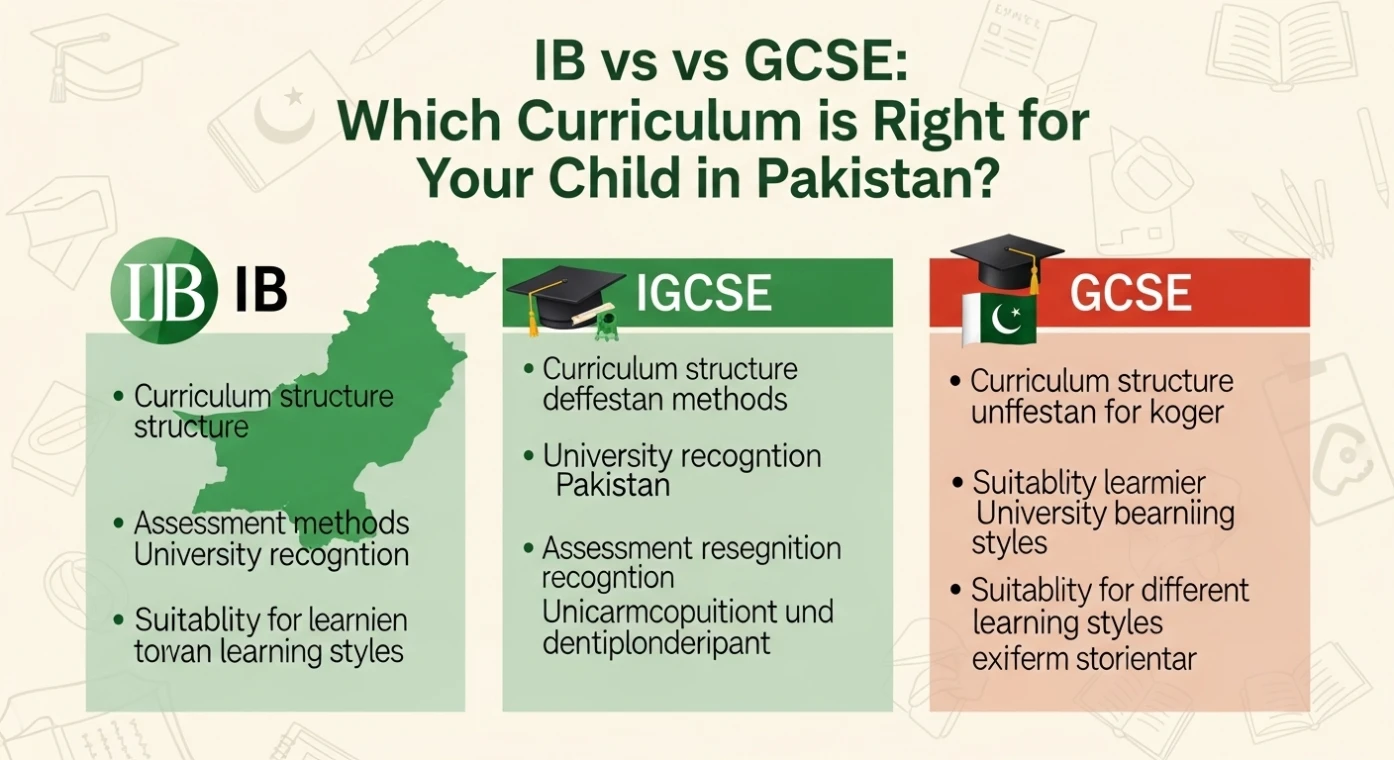
- Quick Overview — What Are IB, IGCSE, and GCSE?
- IGCSE in Depth — Structure, Grading & Pakistan Context
- GCSE Explained — UK Qualification & Pakistan Relevance
- IB in Depth — MYP, Diploma Programme & Pakistan Context
- IB vs IGCSE vs GCSE — Side-by-Side Comparison
- University Pathways — LUMS, AKU, UK, US & Beyond
- Which Curriculum Should Your Child Choose?
- Frequently Asked Questions
If you are a parent in Lahore, Karachi, or Islamabad researching international school options for your child, three curriculum names come up repeatedly: IB, IGCSE, and GCSE. All three are internationally recognised. All three lead to top universities. But they are structured very differently — and for Pakistani students specifically, the implications for university admissions, home tuition needs, and long-term academic trajectories diverge significantly.
This guide cuts through the confusion with a direct, Pakistan-specific comparison. We cover what each curriculum involves, how they are graded, which pathway best suits which type of student, and — crucially — what each means for admission to LUMS, Aga Khan University, and top UK and US universities from a Pakistani school context. We also explain where home tuition fits in, because regardless of which curriculum your child follows, the role of personalised tutoring in achieving top grades is consistent across all three.
IGCSE — The Dominant International Curriculum in Pakistan
The International General Certificate of Secondary Education (IGCSE) is, by far, the most widely offered international qualification in Pakistani schools. Delivered primarily by Cambridge International Examinations (CIE) and secondarily by Edexcel, it is taken by students aged 14–16 — roughly Years 10 and 11 — across LGS, Beaconhouse, LACAS, Roots Millennium, and hundreds of other schools nationwide.
Students typically sit 8 to 10 IGCSE subjects, which may include compulsory cores (English Language, Mathematics, one Science) and a combination of electives from Humanities, Sciences, Languages, and Commerce. Subjects are assessed primarily through final written examinations, with some including coursework or practical components (notably Sciences and Art & Design).
IGCSE Grading
Cambridge IGCSE grades run from A* (highest) to G (lowest), with U for ungraded. Edexcel IGCSE uses the 9–1 scale, where 9 is the highest. In Pakistani schools, the Cambridge A*–G scale is standard. An A* requires mastery of both the core and extended content — typically above 90% in final examinations — and is the target grade for students aiming at competitive A Level colleges and universities.
IGCSE in Pakistani Schools — What Parents Need to Know
IGCSE is the standard pre-A Level qualification at virtually every top Pakistani school. Achieving strong A* grades — particularly in Mathematics, Physics, Chemistry, Biology, English Language, and Economics — is the primary requirement for entry into competitive A Level programmes at LGS, Beaconhouse, LACAS, and Aitchison. For students targeting LUMS, Aga Khan University, or UK Russell Group universities after A Levels, IGCSE A* results form the foundational credential that opens each subsequent door.
Home Tuition Insight: The subjects most frequently requiring home tuition support in IGCSE are Mathematics, Physics, Chemistry, and English Language. The gap between a B and an A* is often 8–15 marks — a gap that targeted past paper practice with a subject specialist reliably closes. Roots Home Tutors provides IGCSE-specialist tutoring across Lahore with a 2-day free trial.
GCSE — The UK Qualification Pakistani Parents Need to Understand
GCSE — the General Certificate of Secondary Education — is the national school-leaving qualification in England, Wales, and Northern Ireland. It is taken at ages 14–16, covers a similar age and stage to IGCSE, and is assessed on a 9–1 numerical scale (9 being the highest, replacing the former A*–G system). Core subjects include English Language, English Literature, Mathematics, and at least one Science. Students typically sit 8–10 GCSEs over two years.
GCSE vs IGCSE — Key Differences
While GCSE and IGCSE cover similar academic territory, there are important structural differences. GCSE is designed specifically for the UK national curriculum, with content and assessment criteria tailored for England and Wales. IGCSE, by contrast, is designed for an international audience — it has been adapted to be culturally neutral and recognisable by universities worldwide. IGCSE also places a stronger emphasis on final written exams with less mandatory coursework than many GCSE specifications, which is why it is better suited to Pakistan’s examination culture.
Both qualifications grade on comparable scales and are recognised by UK universities, but GCSE is not routinely offered in Pakistani schools. Families relocating from the UK to Pakistan will find that GCSE results are recognised at A Level colleges, but the standard progression route in Pakistan is through IGCSE. Students moving in the reverse direction — from Pakistan to the UK — may need to provide IGCSE transcripts as GCSE equivalents, which UK admissions offices consistently accept.
| Feature | IGCSE | GCSE | IB Diploma |
|---|---|---|---|
| Age Range | 14–16 | 14–16 | 16–18 |
| Offered in Pakistan | ✅ Widely available | ❌ Rarely available | ✅ Select schools |
| Number of Subjects | 8–10 subjects | 8–10 subjects | 6 subjects + core |
| Grading Scale | A*–G (Cambridge) | 9–1 | 1–7 per subject (max 45) |
| Assessment Style | Mostly final exams | Exams + coursework | Exams + IA + EE + CAS |
| Subject Flexibility | High | High | Moderate (must cover all 6 groups) |
| Learning Focus | Subject knowledge + exam technique | Subject knowledge + applied skills | Critical thinking + research + global perspective |
| Leads to | A Levels or IB Diploma | A Levels (UK) | University (direct entry) |
| Best for | Pakistan-based international students | UK-based students | Globally mobile / US-targeting students |
IB (International Baccalaureate) — The Global University Pathway
The International Baccalaureate is a globally standardised education system delivered by IB-authorised schools worldwide. In Pakistan, IB is offered at a smaller number of schools compared to Cambridge — including TNS Beaconhouse and International School Lahore (ISL) — but its presence is growing as families target US, European, and globally diverse universities.
The IB organisation offers four programmes, but the two most relevant to Pakistani secondary students are the Middle Years Programme (MYP) for ages 11–16 and the IB Diploma Programme (DP) for ages 16–18.
IB Middle Years Programme (MYP) — Ages 11–16
The IB MYP runs alongside or in place of IGCSE at some Pakistani international schools. It covers eight subject groups — Language & Literature, Language Acquisition, Individuals & Societies, Sciences, Mathematics, Arts, Physical & Health Education, and Design. The MYP emphasises inquiry-based learning, interdisciplinary connections, and a culminating Personal Project in Year 10 — a long-form independent research task. Assessment is primarily through internal teacher evaluation rather than external exams, with optional external moderation available.
IB Diploma Programme (DP) — Ages 16–18
The IB Diploma is a two-year pre-university qualification equivalent in timing to A Levels or FSc. Students study six subjects — one from each of six groups — and must take three at Higher Level (HL) and three at Standard Level (SL). Unlike A Levels, where students can specialise entirely in Sciences or Humanities, the IB mandates breadth: every student studies a language, a second language or humanities subject, a science, mathematics, and electives. This structure is by design — the IB aims to produce well-rounded, globally literate graduates.
Beyond the six subjects, IB Diploma students complete three core components that have no A Level equivalent:
A philosophy-of-knowledge course exploring how we know what we know. Assessed through an essay and presentation. Develops critical thinking valued by top global universities.
A 4,000-word independent research paper on a student-chosen topic. Equivalent to an undergraduate dissertation in miniature. Demonstrates research skills to Oxbridge and Ivy League admissions offices.
A structured programme of extracurricular activities spanning creative, physical, and community service dimensions. Documented and reflected upon throughout the two years.
IB Diploma scores range from 1–7 per subject, with up to 3 bonus points for TOK and the Extended Essay, giving a maximum total of 45 points. A score of 24 is the minimum passing threshold; competitive UK and US universities typically look for scores of 38–42+. In Pakistan, IB tuition needs are significant — the Extended Essay and Internal Assessments require sustained individual guidance that class teachers alone rarely provide comprehensively.
University Pathways — What Each Curriculum Means for Pakistani Students
University outcome is the single most important factor for most Pakistani families evaluating curriculum options. Here is how each pathway performs for the destinations that matter most:
IGCSE → A Levels is the dominant pathway. LUMS merit scholarships are primarily awarded to students with 5+ O Level A*s and 3+ A Level As. The IB Diploma is accepted and can be advantageous for LUMS Humanities/Law programmes. AKU medical admissions require strong A Level Biology/Chemistry results.
IGCSE → A Levels is the best-understood pathway by UK admissions offices. Oxbridge and Russell Group institutions process thousands of Cambridge applications from Pakistan annually. GCSE results from UK-based students are directly comparable. IB Diploma scores of 38+ are equally accepted.
IB Diploma is preferred by many US institutions and can earn college course credits. Common App accepts both IB and A Level transcripts. Harvard, MIT, and Ivy League schools regularly admit Pakistani IB Diploma holders. Strong A Level results with SAT/ACT scores are also a viable pathway.
Both IB and IGCSE/A Level pathways are well-recognised at University of Toronto, UBC, and Australian Group of Eight universities. IB often earns credit exemptions at Canadian universities. Cambridge A Level results are consistently accepted at all major institutions.
Which Curriculum Should Your Child Choose? A Practical Framework
There is no universally correct answer — but for most Pakistani families, the decision framework is clearer than it appears:
Choose IGCSE if: your child attends a Cambridge-affiliated school in Lahore, Karachi, or Islamabad; is targeting LUMS, AKU, or UK universities through A Levels; excels in structured, exam-based assessments; or if you need the widest choice of A Level colleges in Pakistan — virtually all of which accept Cambridge IGCSE as their entry qualification.
Choose the IB Diploma (after MYP or IGCSE) if: your child is enrolled at an IB-authorised school; is targeting US, Canadian, or European universities directly; thrives in independent research and project-based learning; or if global-citizen development and breadth of knowledge are priorities alongside academic achievement.
GCSE is most relevant if: your child is based in the UK or relocating between the UK and Pakistan. GCSE results from UK schooling are fully recognised by Pakistani A Level colleges and vice versa with IGCSE.
Regardless of whether your child is sitting Cambridge IGCSE, GCSE, or the IB Diploma, personalised one-on-one tutoring consistently produces better outcomes than school instruction alone. Class sizes of 20–30 students mean teachers cannot pace to every individual. The students who achieve 7+ A*s in IGCSE, 9s in GCSE, or 40+ in IB are those whose learning gaps are identified early and addressed with targeted, subject-specialist support.
How Roots Home Tutors Supports All Three Curricula
Roots Home Tutors provides expert one-on-one home tuition for IGCSE, GCSE, and IB Diploma students across Lahore and Pakistan. Every tutor is briefed on the specific syllabus, mark scheme expectations, and past paper patterns relevant to the student’s school and examination board — whether that is Cambridge, Edexcel, or the IB. For IB students, we provide dedicated support for Internal Assessments, the Extended Essay, and Theory of Knowledge, in addition to subject-specific preparation.
Book a 2-Day Free Trial — IGCSE, GCSE & IB Tuition in Lahore
Expert one-on-one tutoring for all subjects across Cambridge IGCSE, Edexcel, and IB Diploma. Female tutors available. School-specific syllabus alignment. Serving students across Lahore since 2015.
Book Free Trial NowFrequently Asked Questions — IB vs IGCSE vs GCSE
The IB Diploma is generally considered more demanding than IGCSE — primarily because it covers six subjects simultaneously plus Theory of Knowledge, an Extended Essay, and CAS activities. IGCSE is a subject-specific qualification where students can focus their revision narrowly. That said, difficulty is relative to the student: those who excel at independent research and project-based work often find IB more natural than IGCSE’s exam-focused structure.
LUMS accepts both IGCSE/A Level and IB Diploma. The most common successful pathway from Pakistani schools is Cambridge IGCSE followed by A Level — with merit scholarships typically going to students with 5+ A*s at O Level and 3 As at A Level. The IB is equally accepted and can be advantageous for LUMS Law, Social Sciences, and Humanities programmes where the Extended Essay demonstrates research capability.
GCSE is a UK national qualification and is not routinely offered in Pakistani schools. The international equivalent offered in Pakistan is Cambridge IGCSE. Students who have sat GCSEs in the UK and moved to Pakistan will find their results recognised at A Level colleges. Students moving from Pakistan to the UK will present IGCSE results as GCSE equivalents — a straightforward and widely accepted equivalency.
Yes — IGCSE is the standard prerequisite for A Level study at all major Pakistani colleges including LGS, Beaconhouse, LACAS, and Aitchison. Strong IGCSE results, especially A*s in Science and Maths, are typically required for entry into competitive A Level programmes. The IGCSE-to-A Level pathway is Pakistan’s most established route to top domestic and international universities.
For UK universities, IGCSE followed by A Levels is the most familiar and well-processed pathway. For US and Canadian universities, the IB Diploma is often preferred and can earn course exemptions. Both pathways produce admitted students at Oxford, Cambridge, Harvard, MIT, and top global institutions — the decision should depend on which specific universities the student is targeting and which learning style suits them better.
Final Verdict — IB vs IGCSE vs GCSE for Pakistani Students
For the overwhelming majority of Pakistani students, IGCSE is the right starting point — it is widely available, leads directly to A Levels, and is the qualification Pakistani universities understand best. The IB Diploma is an exceptional alternative for students at IB-authorised schools who are targeting US, European, or globally diverse universities and who thrive in a broad, research-intensive academic environment. GCSE is primarily relevant for families moving between the UK and Pakistan.
What matters more than curriculum choice, however, is how well a student performs within whichever system they are in. A student with 8 IGCSE A*s who takes supplementary home tuition for A Level Chemistry and Mathematics will consistently outperform a peer at the same school who relies on class instruction alone. The same principle holds for IB — Extended Essay support, Internal Assessment guidance, and TOK coaching from a specialist tutor are consistently the difference between a 34 and a 40+.
Roots Home Tutors supports students across all three curricula with personalised, school-specific tuition and a 2-day free trial. Contact us to discuss your child’s curriculum, school, and university targets — we will match them with the right specialist tutor today.